
Deal Stage Design: how to build a sales process your team can actually follow
by Oscar Uribe
One of the most underrated problems in B2B sales organizations is that the sales process is built on a guess. Many CRMs have inherited stages that were created years ago, or someone added new stages as needed without updating the bigger picture.
The result?
A pipeline where everyone works their own way, stages that mean different things to different people, and leadership getting forecasts they can't trust.
Deal stage design is about bringing order to this chaos — and building a sales process that everyone can follow, understand, and rely on.
What deal stage design actually is
Deal stage design means that you:
- define clear stages in your sales process
- explain exactly what each stage means
- set criteria for when a deal can be moved forward
- ensure that everyone on the team works the same way
It's not about "more stages" or "fewer stages." It's about the right stages — with the right content.
Why good structure transforms your entire sales team
When deal stages are unclear, problems arise immediately:
- Reps move deals based on gut feeling, not facts
- Forecasts vary depending on who's reporting
- Leadership tries to coach on the wrong basis
- The team gets different pictures of where a deal actually stands
- The customer gets an inconsistent experience
But when the structure is well thought out, everything gets easier:
- Everyone works the same way
- Reports reflect reality
- Coaching becomes concrete
- You see exactly where deals get stuck
- You can automate the right things at the right place
Deal stage design makes the sales process measurable and repeatable, which is the very core of Sales Ops.
How we build deal stages at Funnelfeedr
The key is to start with the customer's journey, not the seller's.
This means each stage should describe what the customer has done — not what the rep has done.
Examples of wrong focus:
- "Demo booked"
- "Proposal sent"
- "Follow-up in progress"
Examples of right focus:
- "The customer has agreed to move forward"
- "The customer has verified the business case"
- "The customer has approved scope and pricing framework"
Sales activities are activities, not stages.
Stages + criteria = the truth in your pipeline
We add entry/exit criteria to each stage, for example:
To enter this stage:
- the customer must have done X
- the conversation must have reached Y
To leave this stage:
- the customer must have confirmed Z
This makes the process impossible to misinterpret.
Funnelfeedr + your CRM: how it works in practice
When deal stages are clear, you can start automating smartly:
- Automatic tasks when a deal enters a certain stage
- Automatic quality requirements
- Reminders when a deal has been stuck in a stage too long
- Dashboards showing where deals get stuck
- Notifications when criteria haven't been met
Funnelfeedr can also enrich data in the background so that each stage is built on accurate information — making reports even more reliable.
Clean deal stage design + clean data = the perfect pipeline.
Common mistakes when companies build their deal stages
Here's what we see most often:
- Stages describe internal activities, not customer decisions
- The team has too many stages (10+ creates confusion)
- Or too few (3 stages = no insight)
- There are no criteria for when a deal can be moved
- Every rep interprets the process differently
- The CRM lacks automation to support the structure
- Deals sit too long in stages that should be short
When this happens, the pipeline becomes more of a feelings map than a source of truth.
A simple model you can use right away
Want to start simple? Try this structure:
- Qualification — The customer matches your ICP and has expressed initial interest
- Discovery / needs analysis — You've understood their problem and the customer has confirmed it
- Solution design / fit verification — The customer agrees the solution addresses the need
- Business agreement — Price, scope, and timelines are verbally approved
- Negotiation / signing — The customer is formally working toward a decision
- Won / Lost
This is a solid foundation that you can then adapt to your industry and sales cycle.
Our pipeline at Funnelfeedr
At Funnelfeedr, we work exclusively with activities until we've booked a first meeting. At that point we create a lead, i.e. the stage before a deal.
If we qualify the prospect during the meeting, we create a deal.
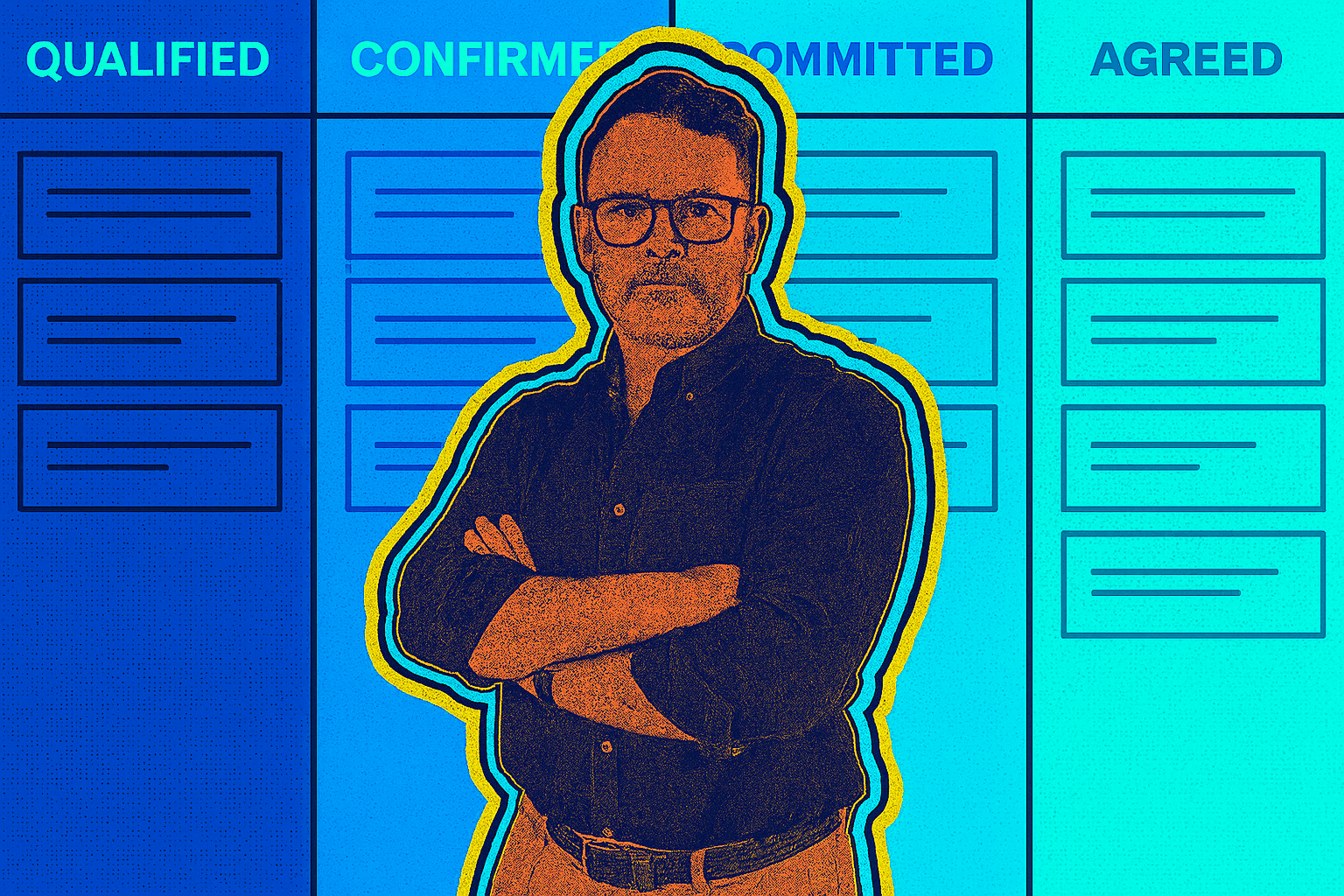
Our deal board has four stages:
1. Qualified
- The customer fits our ICP and has shown initial need and interest
- Here we expect 30% to close
- Each rep should have 20–30 deals here
2. Confirmed
- The customer has confirmed that their problems can be solved with our solution. They might also be looking at competing solutions — that's actually a good sign that they'll move forward and buy one of the options.
- Here we expect 60% to close
- Reps should have 10+ deals here
3. Committed
- Our champion has confirmed that we are the platform they want to go with.
- 90% will close here
- 3–5 deals should sit here
4. Agreed
- We've received a formal OK and are waiting for signature
- 99% should be won here
- No more than 1–2 deals should be here since you need to chase the signature
Each rep should aim to have 30–40 deals in the pipeline. More than that and you risk losing deals due to poor focus. Fewer than that and you risk missing your targets, so head to the prospecting list that Funnelfeedr keeps constantly filled and chase new meetings!
Checklists per stage
Each stage has a checklist that needs to be filled in. This checklist is set as a pinned note on every deal that's created and helps our reps assess the customer's status.
✔️ Qualified

- Budget:
- Authority:
- Need:
- Timeline (3–6m):
- Vendor(s):
- Pains/Gains:
- Decision process:
- Next steps:

✅ Confirmed

- Champion:
- Why / Why not:
- Competitors:
- Proposal sent:
- Potential roadblocks:
- Next steps:

🤝 Committed

- Price/terms OK by FB/Champ:
- Signatory identified:
- Decision date (<30d):
- Actual roadblocks:
- Next steps:

🏆 Agreed
- Signatories invited:
- EB confirmed price & terms:
All deals in deal stages MUST have an upcoming activity and they must rot if they've been sitting in a stage for too long.
In our weekly 1-on-1s, we look at deals from right to left and discuss what can be done to move them forward and whether it's time to close-lost a darling that the rep has been hoping on for too long.
Building good deal stages isn't administrative — it's a way to unlock speed.
Three key takeaways
- Deal stages should be built on the customer's journey, not the seller's activities
- Each stage needs clear criteria to create consistency
- Good deal stage design makes everything in the sales process easier to measure, manage, and improve
Want stages with built-in exit criteria your whole team actually follows? Book a demo and see pipeline playbooks in Funnelfeedr.