
Summer = Dead Phones? Not Anymore.
by Oscar Uribe

It's easy to assume that summer is a lost cause for phone-based sales. Calendars fill up with out-of-office replies, decision-makers "will be back in August," and many organizations hit the brakes right after Midsummer.
But the data tells a completely different story.
Together with our customer Reliable, we took a closer look at how reachability, hit rate, and overall effectiveness actually develop over the summer — week by week. The results are both clear and surprising: it's often unexpectedly effective to reach people by phone even during summer.
Reachability drops — but that doesn't mean deals do
Let's start with what everyone "knows": reachability drops during summer. After Midsummer, fewer people answer the phone, and the curve continues downward toward the end of July. That's true, and it shows clearly in the numbers.
But here's the important insight.
While fewer people answer, the hit rate increases significantly. When you do get through, the chance of booking a meeting is considerably higher than during a normal workweek the rest of the year. In Reliable's data, we see a hit rate that climbs by around 25–30% during several summer weeks.
The explanation is fairly logical: the people who are actually at their desks have more breathing room in their calendars, fewer internal meetings, and more time to take a call — and to actually engage with the content.
Overall effectiveness: better than a typical week
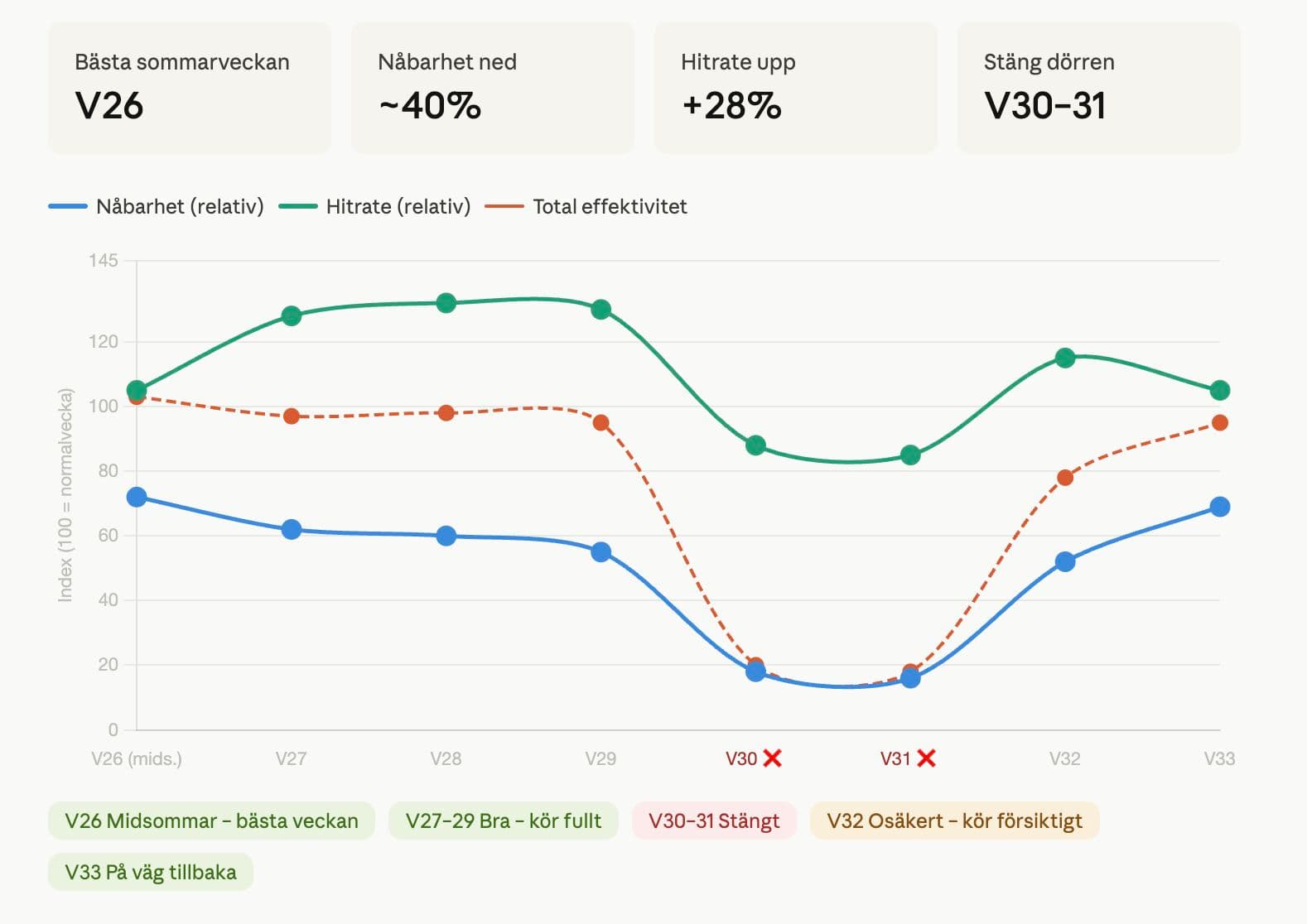 Reachability, hit rate, and overall effectiveness during summer weeks — data from Reliable.
When you combine the two factors — lower reachability but higher hit rate — the result becomes even more interesting. The overall effectiveness (meaning actual business impact) lands during several summer weeks at the same level, or even higher, than an average week during the rest of the year.
In the graph from Reliable, weeks 26–29, right after Midsummer, stand out in particular. There we see:
- Declining reachability
- Sharply increasing hit rate
- An overall effectiveness that holds up very well compared to "peak season"
In other words: summer isn't dead. It's just different.
Two weeks that deserve a vacation
That said — there are exceptions.
One thing is consistent in the data: weeks 30 and 31.
Here, reachability falls to levels that make it hard to justify continued calling. Even though the hit rate is still okay, the volumes are so low that overall effectiveness plummets. There are simply too many people who are completely off the grid.
Our clear recommendation, based on several years of measurements: 👉 take your vacation during weeks 30–31.
Those are often the only two weeks of the year where the phone can genuinely rest with a clear conscience.
Conclusion: dare to call — strategically
Summer doesn't have to be three wasted months. On the contrary, when used right, it can become a strategic advantage. When your competitors log off after Midsummer, you have the opportunity to:
- Reach decision-makers who have more time and focus
- Book meetings with a higher connect-to-meeting rate
- Build pipeline while others wait for "the fall"
Keep pushing through the end of July. Take time off when it's truly at its quietest. And be ready when the calls pick up again in August.
The phone works in summer too — just not exactly the same way as in winter.
Want to make the most of summer reachability? Book a demo and see how the dialer keeps your team dialing while competitors pause.