
Three Clients, One Construction Company: Why Meeting-Booking Agencies Need One Account per Client
by Oscar Uribe
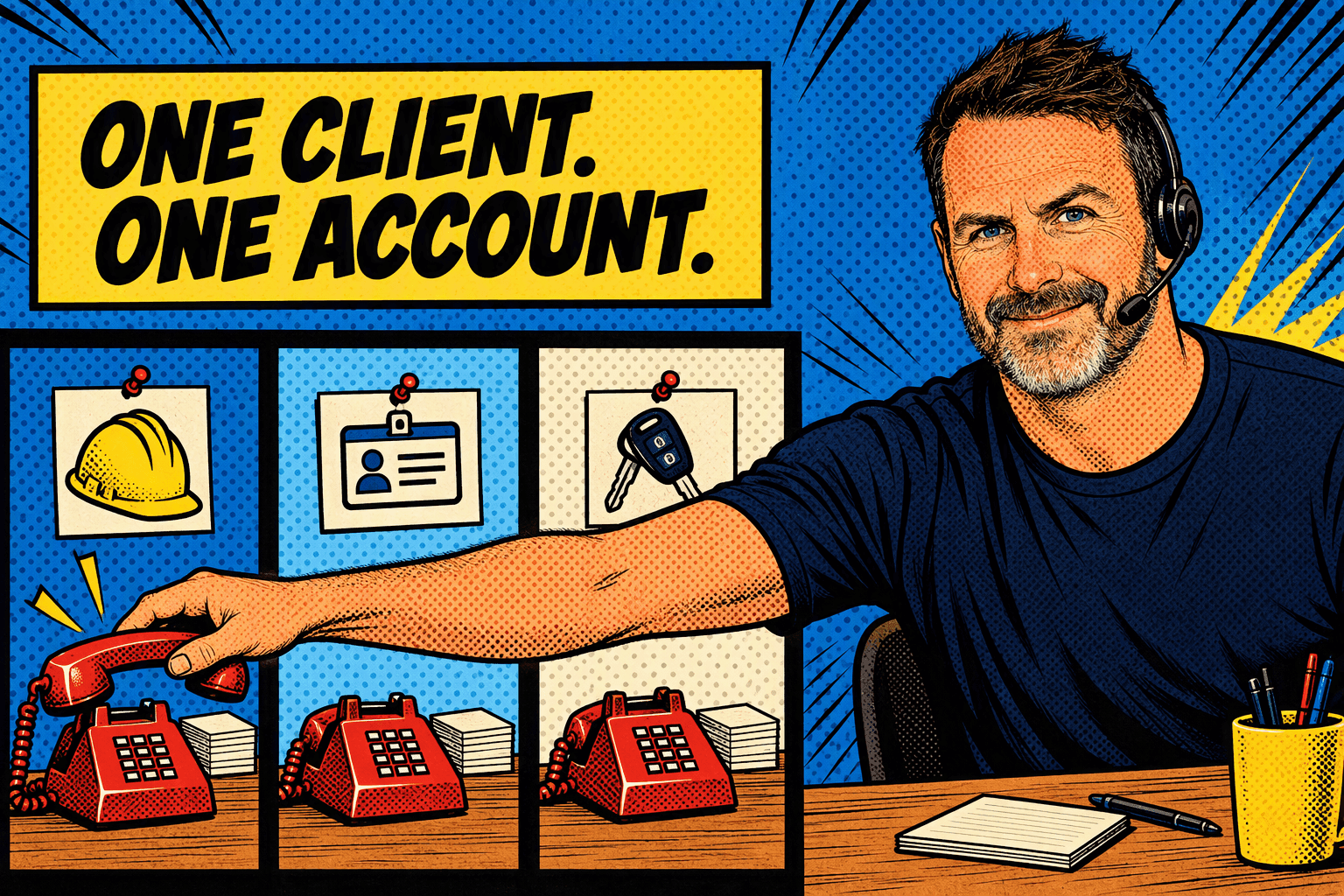
The founder of a lead-generation agency put the problem to us in two sentences, and I haven't heard it described better:
"One SDR can be calling for three campaigns at once, and our clients all chase the same accounts. After a few rounds it's a mess, because everything lands on the same customer card."
Picture the card. A large construction company, one regional manager. On Monday a booker calls him for a client selling site safety software. On Wednesday a colleague calls him for a staffing firm. On Thursday someone calls for a fleet leasing company. All three calls are logged on one record, with notes that mention three offers, two objections and one "call me after the budget meeting" that nobody can tell which client it belonged to.
Then the month ends, and each client wants a report on their campaign. Someone spends a day untangling it by hand.
This post is for the people who run meeting-booking agencies, outsourced SDR teams, and freelance bookers who work for more than one client. It covers why one shared system breaks, the model that holds up, and six rules for running it.
How agencies end up in the mess
Almost every agency we talk to runs one of three setups, and each has a predictable failure.
One system for everything. All clients in the agency's own CRM or dialer. It's cheap and simple until two clients want the same company, which in the Nordics happens within weeks. The market for most B2B offers is a few thousand companies, and every client wants the biggest hundred.
The client's system, per client. The booker logs in to each client's CRM. This keeps clients apart, but a consultant on four projects has four logins, four ways of logging a call, and four places where the list lives. One agency told us their biggest problem is the first week on a new project: new client, new consultant, and days spent finding people and learning the system before anyone dials. What they want is a consultant who "just sits down and starts calling."
Spreadsheets. Lists bought from one place, numbers from another, imported and de-duplicated by hand per client. It works until a list goes out twice, or a contact who said no to client A gets a call from client B the same afternoon.
The common thread: the agency's structure (several clients, shared people, overlapping markets) doesn't match the structure of the tool.
What the client is actually paying for
Clients pay for meetings. But over three or six months they also pay for something they rarely put in the contract: what the agency learns about their market. Which segment answers, which titles book, which objection comes up on every third call and what answer works.
When the engagement ends, that knowledge is the most valuable thing in the room, and the client knows it. An agency owner described it plainly: clients want to own the data, and when an engagement ends they want everything that happened. Another reacted to the idea that the client's own sellers could take over the objection library after the agency leaves with two words: "spot on."
That's the argument for the model below. Not tidiness, but the fact that the work belongs to the client and should be kept where it can be handed over.
The model: one account per client
Each client gets its own account. Inside it sit that client's ideal customer profile, exclusions, lists, scripts, objections, notes and call history, and nothing from any other client. The bookers who work on the client get access to that account and switch to it when they work the project.
The market underneath can be shared. The company registry and the public contact data are the same for everyone, and there's no reason to buy the market once per client. What can't be shared is the work on top: who was called, what they said, what was promised.
Six rules for running it
1. Exclusions first, before the first dial
The client's existing customers, their open deals and the companies they have told you not to touch go into the client's account before anyone builds a list. Nothing burns trust faster than a booker calling a client's biggest customer to pitch them the product they already use. Ask for the customer list in the kickoff meeting, not after the first complaint.
2. The booker shows up as the client
Book meetings from the client's mailbox and domain, not the agency's. The prospect is meeting the client, and the invite should say so. The same goes for the number on the prospect's screen: one agency we spoke to wants the caller ID to fit each project, so a callback lands with the right campaign instead of at a switchboard that has to guess.
3. Consultants see only their own clients
A booker on two projects needs two accounts, not twelve. Limit access per client, and make switching between clients deliberate. One seller admitted to us that he had updated the wrong client's account that same morning. If it can happen to the person demonstrating the tool, it will happen to a part-time booker on their third project of the day.
4. Count held meetings, not booked ones
Most agencies are paid per meeting, and many clients only pay for meetings that actually happen. That makes the calendar part of the job. One founder told us they have someone working half-time doing nothing but logging in to "fourteen Outlooks and seven Gmails" to see who accepted the invite.
Track two things per booked meeting: did the prospect accept, and did the meeting take place. When a client questions a meeting, have the call where it was booked ready to play. The recording ends the argument faster than any report.
5. Let the client's objections stay with the client
"We already have an LMS" is a client-specific objection. The answer that works for one client is wrong for the next. Build each client's objection library from their own calls, inside their own account, so a new booker on the project gets the answers that have worked for that client, and the client can take them home.
6. Budget for paying twice
Here's the honest cost of the model. The same regional manager may need to exist in three client accounts, with his contact details in each and no shared history. A Norwegian agency we spoke to went straight to the trade-off: in a strict silo you pay for the same contact more than once.
It's still the right call. A shared history would mean client B's booker reading what client A's booker discussed with the same buyer, which is exactly the leak clients are afraid of. Price the overlap into the client agreement as a data budget per client, and it stops being a surprise.
Day one for a new consultant
When the model works, a new consultant on an existing project opens the client's account and finds the ideal customer profile, the exclusions, a list that's already been worked, notes on every contact, recordings of the best calls, and the objections with the answers that booked meetings. They can build today's list over lunch and call it the same afternoon.
When the model doesn't work, they get a spreadsheet and a script, and the client pays for a week of someone learning what the previous consultant already knew.
Write the handover into the contract
Decide on day one what the client gets on the last day. A reasonable default: the list with every contact's status, the objection library, the recordings behind every booked meeting, and the notes. Clients who know they'll get the work back are easier to sign, and they leave on better terms, which is how agencies get the next project.
How we do it
In Funnelfeedr, an agency runs one account per client under the same subscription. A booker has one login, sees only the client accounts they've been given access to, with a role per account, and switches between them in the menu. Switching is blocked during a live call.
Each client account holds its own lists, ideal customer profiles, notes, call history with recordings and transcripts, CRM connection, and knowledge base with objections, so live coaching prompts the answers that have worked for that client, not another. Searches can exclude the client's CRM companies or only their customers, an imported customer list, or companies marked as customers or partners. Each booker connects the client's mailbox inside that client's account, so meetings are booked from the client's domain.
For meetings booked through Funnelfeedr, the system tracks whether the prospect accepted the invite, and whether the meeting was actually held or was declined or a no-show. Rule 6 applies to us too: a contact revealed in two client accounts is paid for in both. Credits are shared across the agency's accounts, and one seat per booker covers every client account they work in. Lists can be exported to Excel or CSV for the handover.
More on how agencies use the dialer, live coaching and recordings is on the meeting-booking agency page, and the data side of the booking rate is in why your booking rate is capped by data.
Running several clients from one set of logins? Book a demo and we'll set up two client accounts side by side →