
Document, Train, or Build It In: Where Should Your Sales Process Actually Live?
by Oscar Uribe
At some point, most sales leaders have the same uncomfortable realization: the sales process in the official slide deck is not the sales process the team actually runs. The real one — which questions get asked, how the hard objections get handled, what actually closes — lives in the heads of three or four people. We've written before about why that knowledge belongs to the company, not the rep, and what it does to ramp time when it doesn't.
This post is about the question that comes after the realization: what do you actually do about it?
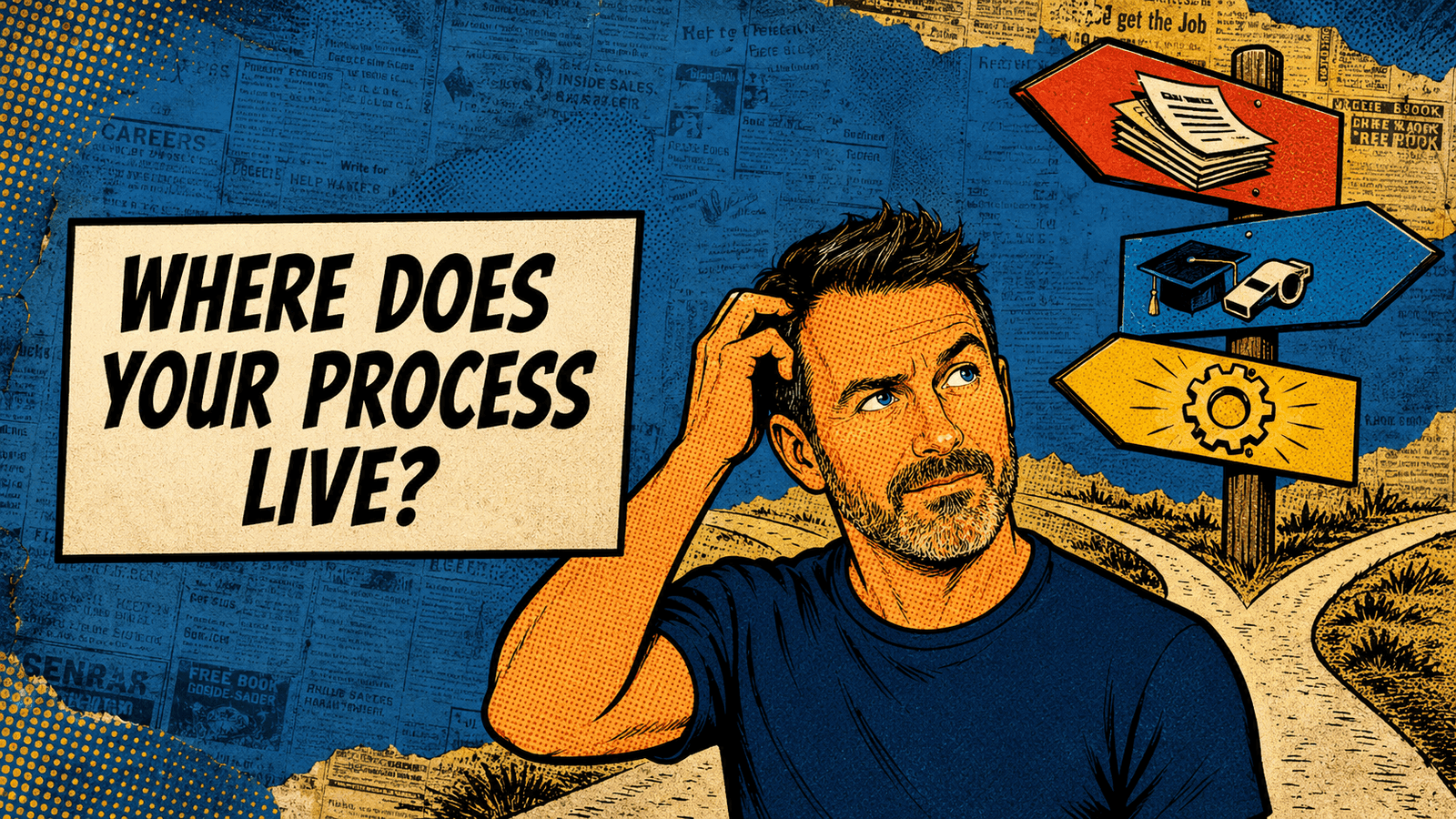
Because once you start looking for a fix, you'll find three fundamentally different routes, each with its own vendors, its own price tag, and its own failure mode. Write it down. Train it in. Or build it into the workflow. Most teams end up doing some of each — but they're not interchangeable, and picking the wrong lead horse wastes a year. Here's the honest comparison.
Route one: write it down
The playbook document. A Notion workspace, a Confluence space, a forty-page PDF titled "Sales Playbook v2 FINAL". It's the cheapest route, the fastest to start, and for many teams it's the right first move.
What it does well. Writing the process down forces you to articulate it, and that exercise alone is valuable — the arguments about what should be in the document are often the first time the team discovers they disagree about how you sell. A written playbook is also a genuinely useful onboarding artifact: day-one reading that gives a new hire the map.
Where it breaks. Three places, reliably.
First, a document is a snapshot, and your sale is a moving picture. The playbook records what someone believed the day they wrote it. Then pricing changes, a new competitor shows up, a new objection starts appearing in calls — and updating the document is nobody's job. Ask any team with a playbook when it was last edited. If the honest answer is "when it was created," you don't have a playbook. You have a museum.
Second, documents answer questions reps have time to ask — and selling happens at moments they don't. No rep, mid-call, facing "we already have a supplier for this," is going to open Confluence and search. The document could contain a brilliant answer to exactly that objection. It doesn't matter. Help that isn't present at the moment of need might as well not exist.
Third, there's no feedback loop. The document doesn't know what your best rep started saying last month that's suddenly winning deals. It can't learn. Every improvement requires a human to notice something works, remember the document exists, and go edit it — three steps that each fail more often than they succeed.
Route two: train it in
Workshops, external sales trainers, certification programs, role-play sessions, manager call reviews. This is the route with the biggest industry behind it, and the most seductive pitch: change the reps, not the tooling.
What it does well. Training is the only route that builds skill — the muscle-memory parts of selling that no document transfers. If your problem is that reps present instead of asking, or fold at the first "no," a good trainer and deliberate practice genuinely move the needle. Live role-play with feedback does something reading never will.
Where it breaks. Also three places.
First, decay. The forgetting curve is brutal and nobody is exempt: without systematic reinforcement, most of what a workshop installs evaporates within weeks. Teams buy a two-day training, see a real bump, and watch it fade by the next quarter — then buy another one. That's not a knowledge system; it's a subscription to temporary enthusiasm.
Second, training is episodic and your sale changes continuously. The workshop happens in March. The new objection shows up in May. The trainer isn't there in May.
Third, the coaching version doesn't scale, and it arrives late. Manager call reviews are the best form of training there is — and they're bottlenecked by manager hours, which is why in practice each rep gets a fraction of what they need. Worse, review-based coaching is after the fact by definition. The feedback helps the next call. It does nothing for the call where the deal actually died.
Route three: build it into the workflow
The third route puts the process inside the tools where selling already happens. The qualification framework becomes fields on the deal, not a chapter in a PDF. Objection answers become battle cards that surface during the call, at the moment the objection lands — not in a document nobody opens. Calls and meetings get captured automatically, so what top reps actually say feeds a knowledge base that stays current because it's built from real conversations, not from someone's memory of them.
What it does well. It fixes precisely the three failure modes of the other two routes.
The moment-of-need problem: the answer arrives mid-conversation, when it can still change the outcome — this is what real-time coaching actually is, the systematized process reaching the rep live instead of in next week's review. The staleness problem: a system fed by every call updates itself; when your best rep finds a new answer that works, it's captured where the next rep can use it, without anyone remembering to edit anything. And the resignation problem: when that rep leaves, their questions, answers, and deal context stay in the system. The knowledge stops walking out the door.
There's a compounding effect the other routes don't have: every call makes the system slightly better, which makes every rep slightly better, which makes the next call's capture slightly better. Documents rot and training fades — a workflow system is the only one of the three that appreciates.
Where it breaks — because this route has honest weaknesses too.
It requires adoption. If your team runs its real work in inboxes and spreadsheets and only visits the sales tool under duress, then process-in-the-tool is just a document with extra steps. The route only works when calls, meetings, and follow-ups genuinely run through the system — which is an argument for having them run through the system, but it's a real precondition.
It requires an upfront capture effort. The system learns from your calls going forward, but seeding the first battle cards and the initial knowledge base takes deliberate work from whoever knows the sale best.
And it costs money, where Notion is "free" — free, that is, if you don't count the cost of the version nobody reads, which we tried to put a number on in what it costs to do nothing.
The five questions that actually decide it
Strip away the vendor decks and the choice comes down to five questions. Ask them about any option you're evaluating — including the one you're using now:
- When does the answer arrive? After the call is review. During the call is coaching. Only one of them can save the deal in progress.
- Who maintains it — a person or the system itself? Whatever you're evaluating: ask what updated it last month. If the answer is "a person, in theory," you know how this ends.
- What walks out the door if your best rep resigns on Friday? Run the thought experiment concretely. Their objection answers? Their deal context? Their discovery questions? Anything not in a system is on that Friday's departing laptop.
- The ramp test. How long until rep number six sounds like rep number one — and can you measure it? A route that can't shorten ramp isn't systematizing anything; it's decorating the org chart.
- How far is the knowledge from where reps already work? Every tab-switch, every search box, every "I'll look it up after" is distance — and distance is where adoption goes to die.
When each route is right
Write it down when you're founder-led or hiring your first rep, when the sale is changing so fast any system would be re-seeded monthly, or when budget is genuinely zero. The document is also always the right starting artifact — you'll need its content to seed anything better. Just go in knowing its shelf life.
Train it in when your problem is skill, not knowledge distribution — reps who can't run discovery or won't ask for the close have a capability gap that no battle card fixes. Buy training for behavior. Don't buy it to distribute knowledge; that's using the most expensive, fastest-decaying medium for the job a system does better.
Build it into the workflow when you have a few reps or more and growing, when you hear the same objections recycling in call after call, when hiring or churn is a live reality rather than a someday, and when your calls and meetings already run — or can run — through one system. This is the point where the compounding starts to matter more than the setup cost.
And to be clear: the routes stack. A written playbook seeds the system; training teaches reps to use what the system surfaces. The mistake isn't choosing one — it's leading with a route whose failure mode you can't afford. If what's killing you is knowledge trapped in heads, a workshop won't free it, and a document will hold it for about a quarter.
The real test isn't which route sounds best at the offsite. It's which one is still working in six months without anyone heroically maintaining it. Documents rot. Training fades. Systems compound.
Want to see what your sales process looks like when it lives in the system — battle cards surfacing mid-call, a knowledge base that learns from your best reps' actual conversations? Book a demo and watch every rep become your best rep →