
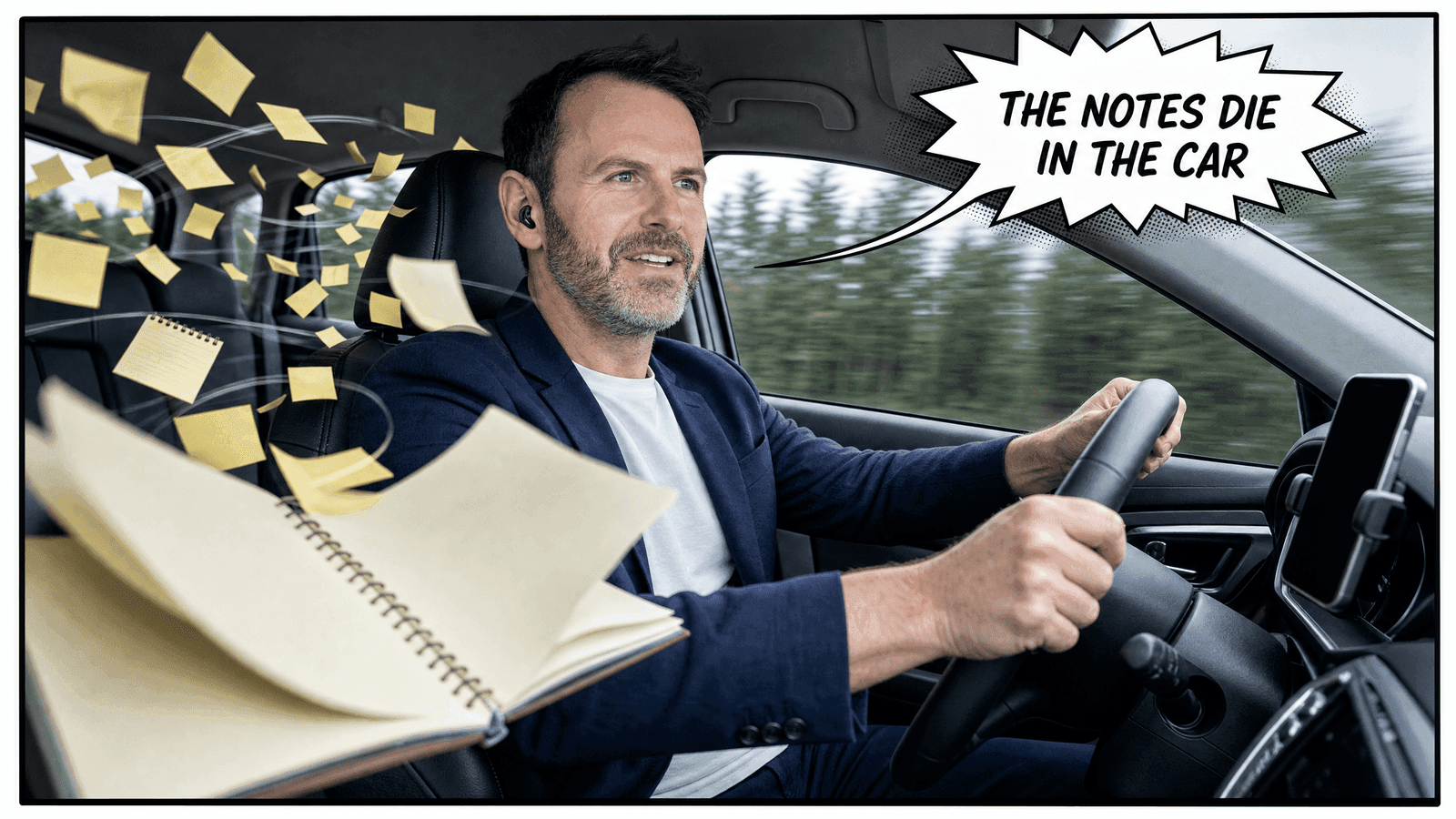
A new-business seller at a software company told us how he works his commute. He drives several hours to Stockholm and back, and the night before, he emails himself a list of the people he wants to call, with every phone number turned into a link. In the car, he taps his way down the email.
"Many of us have travel time where we waste a lot of the day. That time could be used far better working a call list. If I can run it from the car, it's worth a great deal."
A few weeks later, a sales manager at a company with a team of field reps described the same thing from the other side of the desk:
"Many of them are on the road and not great at logging. I know they call a lot, I can see it because deals keep coming in. But the data never makes it into the system."
Between those two sits most of field sales. The rep is working, often harder than anyone at a desk. The manager can see the result. And everything in between, who was called, what was said, what was promised, lives in the rep's head until it doesn't.
The car is the field seller's office
For someone who sells face to face, the drive is not a gap between work. It's where a big share of the work happens:
- The best calls happen there. A decision maker who was in meetings all morning calls back at 4:30, when you're on the motorway. You pick up, because that call is worth more than anything else you'll do that day.
- The meeting you just left gets processed there. Fifteen minutes after you walk out, you know exactly what the customer meant, who actually decides and what you promised to send. An hour of driving later, half of it has faded.
- The callbacks get made there. "Call me next week" turns into a call from the car on Tuesday, because Tuesday you're driving between two customers anyway.
One buyer put it simply in a first meeting with us: a lot of calls happen in the car, and afterwards they can't remember what was said. The first question another commercial lead asked us was whether he could call through the system while driving.
The problem is not that field sellers are lazy about notes. It's that the place where the information is created is the one place where they can't, and shouldn't, write anything down.
What actually dies on the road
1. What was said. You can't type at 100 km/h, and you shouldn't try. Holding the phone while you drive is banned across the Nordics anyway. So the call ends, the next one comes in, and by the time you park, two conversations have merged into one vague memory.
2. The promise. "I'll send you the reference case." "I'll check whether we can deliver in March." Promises made in the car are the easiest to forget, because there's no screen in front of you when you make them, and nothing reminds you later.
3. The calls themselves. Calls made from a personal mobile don't exist anywhere except the phone's call log. They don't show up in the CRM, nobody else on the team can see that the customer was contacted, and a colleague may call the same person the next day.
4. The manager's view. The manager sees signed deals and an empty activity log, and has two options: trust blindly or nag. Neither helps. A manager who can't see the work can't coach it, and can't tell the rep who is busy from the rep who is stuck.
5. The hours. A field seller who drives eight hours a week and makes no calls in that time has lost a full working day. One who calls from the car but logs nothing has kept the hours and lost what they produced.
Six habits that keep what the road takes
None of this needs new software to start. It needs a few habits that move the writing to where writing is possible.
1. Build the car list at the desk. The seller who emails himself a list of linked numbers has the right instinct. Do it properly: the evening before, pick the five to ten calls that suit the drive. Callbacks that are due, people who replied to an email, customers you're meeting next week. Next to each one, write the one thing you want to find out. Cold calls from a list you haven't researched are a poor fit for the car. Warm calls with a clear purpose work well.
2. Never write while driving. Talk instead. Hands-free for the call, and nothing else in your hands. If you need to remember something mid-drive, the safe version is a voice note to yourself using your phone's built-in voice assistant, started without looking. One line is enough: "Customer X, wants the price for 40 units, call Thursday."
3. Two minutes in the parking lot. Before you start the engine after a meeting, and before you walk into the next one, take two minutes. Write three lines: what they said that matters, what you promised and by when, and what happens next. Two minutes in a parked car beats twenty minutes on Friday afternoon trying to remember Tuesday.
4. Promises get a date, not a mental note. Anything you promise in the car becomes a task with a due date at your next stop, not "I'll remember." If the promise is "next week," pick the day.
5. Calls go through a number the company can see. If the team's calls come from personal mobiles, the team has no shared history. Whatever phone system you use, the customer should be calling a number that belongs to the company, and the call should land on the customer's record. Otherwise the rep who leaves takes the relationship history with them.
6. Managers count conversations, not logged activities. If the only way a manager can see the work is through the CRM, reps who drive will always look worse than reps who sit. Agree on a simple weekly number, real conversations with customers and prospects, and report it every Friday, even if it's by hand at first. That replaces the nagging with a number both sides trust.
A one-week test
You can check how much the road is costing you in a week:
- Monday: each field seller writes down, in the evening, every customer conversation they had that day that isn't in the CRM.
- Every day: they build the next day's car list at the desk, with a purpose per call, and do the two-minute parking-lot note after every meeting.
- Friday: count three things. Conversations that day that would have been lost. Promises that got a date. Calls made from the car that are now on a customer record.
Most teams find the same thing. The calls were always happening. What was missing was the two minutes after them.
How we do it
- The list is built at the desk and worked from anywhere. A call session is a prepared call list that waits until you start it, with due callbacks put first. The dialer works on the phone too, so the list you built last night is the one you work from the car, hands-free.
- Calls through the system write their own notes. Calls made from the dialer are transcribed and summarized. When the buyer says "call me in two weeks" or "send me the price list," a follow-up task is created with the date and the buyer's own words as evidence. With Pipedrive or HubSpot connected, the call is logged to the CRM.
- Callbacks ring your mobile. When a prospect calls back the number you called from, the call is forwarded to your mobile, wherever you are. It's recorded and lands on the customer's record like any other call, so the late-afternoon callback on the motorway is no longer lost.
- The brief arrives before you leave. With the Meet seat, a pre-meeting brief is sent by email at a time you choose, for example 07:00 on the day: what has happened since last time and which commitments are still open. You read it before you start the car, not at a red light.
- Email on the phone still counts. The mailbox is synced on the server side, so an email you read or answer on your phone between meetings ends up on the customer's timeline just like one sent from the desk.
- Next: every call on the mobile. We're building a Telavox integration right now. With it, calls a seller makes on their mobile through the company's switchboard are recorded and analyzed too, not only the ones made through the dialer. Habit 5 then takes care of itself.
The six habits above work with any system. What changes when the calls write their own notes is that the two minutes in the parking lot become a quick check, not a write-up.
Want to see what a field seller's day looks like when the list is ready before the drive and the calls write their own notes? Book a demo and bring your team's real week →field sales · outside sales · sales notes · CRM adoption · follow-up · sales manager · call list · Nordics · B2B