
The Deal Didn't Die in the Meeting. It Died Between Them.
by Oscar Uribe
Prospecting pain is easy to see. You can count dials, connect rates, bounced emails. When an SDR's week goes wrong, the dashboard tells you by Tuesday.
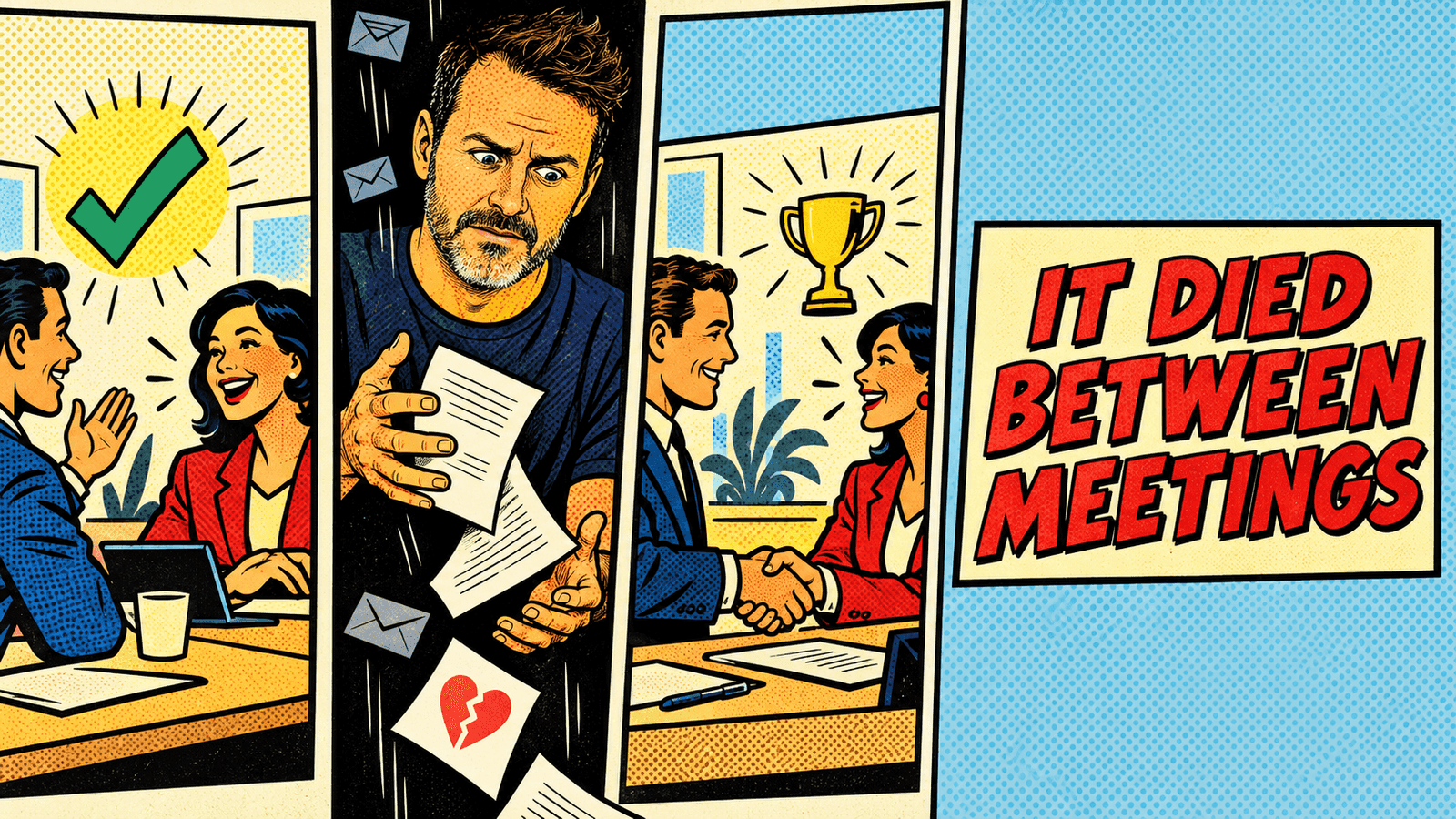
Account executive pain is different. It's quiet. The deal doesn't die in the meeting — the meeting usually goes fine. It dies between meetings: in the follow-up that went out on Thursday instead of Monday, in the "champion" who turned out to be an enthusiast with no budget, in the email thread that cooled by two degrees while the rep was handling three other deals. Nobody sees it happen. The deal just slides a quarter, then another, then quietly gets marked lost with a reason nobody believes.
We've spent the last two months writing about where the sales process should live — in the system, not in reps' heads. This post takes that argument to the part of the funnel where it's least visible and most expensive: the weeks between first meeting and signature. Seven pains, each with what the usual fix gets wrong and what a fix that holds looks like.
1. The admin tax, paid twice
Every AE knows this one, so we'll be brief — we wrote a whole post on it. After every call: notes into the CRM, a summary, a follow-up task, maybe a stage update. After every meeting: the same, plus action items. Multiply by 40 deals and it's hours a week that aren't selling — and then the team pays the tax a second time, because whatever didn't get typed in is gone.
The usual fix: a Friday-afternoon "CRM hygiene" block that nobody keeps. Or a manager who chases.
What holds: the capture has to be automatic or it doesn't happen. Calls transcribed and summarized, meetings recorded by a notetaker that joins on its own, emails logged against the deal without anyone forwarding anything. The test is simple: if a rep does nothing after a call, is the CRM still right? If the answer is no, the tax is still being paid.
2. The follow-up that's a day late
Buyers move on. The proposal follow-up that goes out the same afternoon lands with a warm buyer; the one that goes out Thursday lands with someone who's had two other vendor meetings since. Most AEs know exactly which of their follow-ups are late. They're late anyway — because writing a good one takes twenty minutes and the twenty minutes keep going to whatever's on fire.
The usual fix: templates. Which produce fast, generic follow-ups that read like templates.
What holds: a draft that's already written when the call ends — built from what was actually said, not from a template — that the rep reads, edits, and sends. Two conditions make this trustworthy rather than terrifying. First, the rep approves every draft; nothing goes to a customer unread. Second, every claim in the draft points at the quote it came from, so the rep can check "you mentioned Q1 for the rollout" against what the buyer actually said in thirty seconds instead of re-listening to the call.
3. Qualification by memory
Ask an AE whether a deal is qualified and you'll get a confident yes. Ask who the economic buyer is, and what they said about budget, and when — and the confidence gets thinner. Qualification frameworks like MEDDPICC and BANT exist precisely to force those questions. In practice, the framework lives as six empty fields on the deal record that get filled in from memory the night before pipeline review, if at all. We covered the frameworks themselves earlier; the problem isn't the framework. It's that filling it in is homework, and homework loses to selling every time.
The usual fix: make the fields mandatory. Which produces six fields full of "TBD" and "yes".
What holds: the scorecard fills itself from the conversations that already happened. The economic buyer was named on the second call — it's in the transcript. Budget came up in an email — it's in the thread. Each field gets pulled from where it was said, with the quote attached, so "qualified" stops being a feeling and starts being something a manager can click on and read. The rep confirms or corrects; the gaps light up red. And when a stage is set to require certain fields, an unqualified deal can't slide forward on optimism.
4. The deal that looks healthy right up until it isn't
Some deals die of things that were visible for weeks — to someone who was looking. The deal with one contact, where that contact goes on parental leave. The deal at "negotiation" where nobody with signing authority has been on a call. The deal that hasn't had any activity in twelve days while the rep's attention was on the two bigger ones. None of this is subtle. It's just spread across forty deals, and no human reads forty deals every morning.
The usual fix: the weekly pipeline review, where the manager asks "what's happening with Nordvik?" and the rep answers from memory. Which is how the single-threaded deal gets described as "moving along" for six weeks.
What holds: the board watches the deals so nobody has to. Single-threaded near close, no decision-maker on any call, stalled, ghosted, overdue — flagged automatically, and flagged with the rule ("no activity in 12 days," "one contact, stage: negotiation") so the rep can argue with it if the rule is wrong for this deal. The point isn't a red badge. It's that the deal gets attention on the day it starts to slip, not at the review three weeks later.
5. The signal buried in the inbox
An AE's inbox is where the real state of the pipeline lives, and it's the one place no tool used to look. The buyer who replied "sounds good, let's regroup after the board meeting" — is that a yes or a stall? The thread that went from same-day replies to four-day replies. The reply-all where a new name appeared in CC with a procurement title. Every one of those is a signal, and every one is buried between calendar invites and newsletters.
The usual fix: the rep's gut. Which is good — experienced AEs read tone well — and doesn't scale past the deals they're actively thinking about.
What holds: the inbox gets read the way a good manager would read it if they had the time. Each thread summarized to where the conversation actually stands; intent and sentiment surfaced so a cooling buyer shows up as cooling before the deal goes quiet; objections and buying signals pulled out of the prose and onto the deal. The rep still decides what to do. They just stop finding out three weeks late.
6. Inheriting a deal blind
Two versions of the same pain. The SDR→AE handoff, where the discovery call that booked the meeting exists only as three lines in a CRM note: "interested, has budget, call Tuesday." And the inherited deal — a colleague leaves, or goes on leave, and the AE picks up twelve opportunities with nothing but the stage name and a value.
The usual fix: the handoff meeting, or the leaving colleague's "I'll write up my deals" — which produces a document written in the last week of a notice period by someone already mentally elsewhere.
What holds: the deal memory belongs to the company, not the rep. Every call, meeting, and email on the deal sits on the deal, with summaries, so the new owner can read the whole history in ten minutes and walk into the next call knowing what was promised, what was objected to, and what the buyer said about timeline — the argument we made about sales intelligence generally, applied to the one place it hurts most.
7. The same objection, answered from scratch
Late-stage objections recycle. "We need to check with our current vendor's renewal terms." "Legal wants to see your DPA before we go further." "Can we start with a smaller scope?" Every AE on the team has heard each of these. Every AE has an answer. The answers are different, some are much better than others, and the one that worked last week for the rep in the next seat is unavailable to you — because it lives in their head.
The usual fix: the objection-handling document from route one in our last post. Written once, read never, and silent about which answers actually worked.
What holds: an objection ledger, not a document. Every objection that shows up in a call, meeting, or email gets recorded; every handling of it gets recorded too, along with what happened next. Over time you get something no PDF ever had: this objection, in this context, answered these four ways, with these outcomes. The best answer surfaces during the call, when it can still change something — and it keeps improving because it's built from what the team actually says, not from what someone remembered to write down. It's the same mechanism that shortens ramp time, pointed at the late-stage conversation.
The pattern
Read the seven again and one thing repeats. Every pain is a case of something that was said — on a call, in a meeting, in an email — not being where it needed to be when it mattered. The economic buyer was named; the field was empty. The buyer cooled; nobody noticed. The objection was answered brilliantly; by someone else, last month.
The fix in every case is the same shape: capture the conversation, extract what matters, put it on the deal, and make it available at the moment of need — during the next call, in the next draft, on the board this morning. That's what the intelligence layer of a sales platform is for. Not dashboards. Not another place to type things. A system that has actually heard your deals.
A few things we think are non-negotiable if you're evaluating any of this:
- Evidence, always. Every AI-filled field, every warning, every draft should show the quote or the rule it came from. An AI that says "champion: yes" without showing you where is just a more confident version of the rep's memory.
- Approval before action. Nothing reaches a customer, and nothing enters the team's playbook, without a human saying yes. This is the difference between a tool AEs trust and one they route around.
- One conversation record. Calls, meetings, and emails on the same deal, in one place — otherwise you've automated three silos instead of one.
At Funnelfeedr we packaged this as the Close seat — coached calls, the AI notetaker, email intelligence, evidence-based qualification, and the deal board, for the reps who run deals rather than fill pipeline. But the packaging matters less than the test. Take your three biggest deals right now and ask: what was said on them that isn't on them? If you can answer that quickly, you're in good shape. If you have to go ask the rep, you've found where your next deal is going to die.
Want to see a live deal scored against MEDDPICC from a real conversation — quotes attached, gaps lit up, warnings explained? Book a demo and bring your hardest deal →