
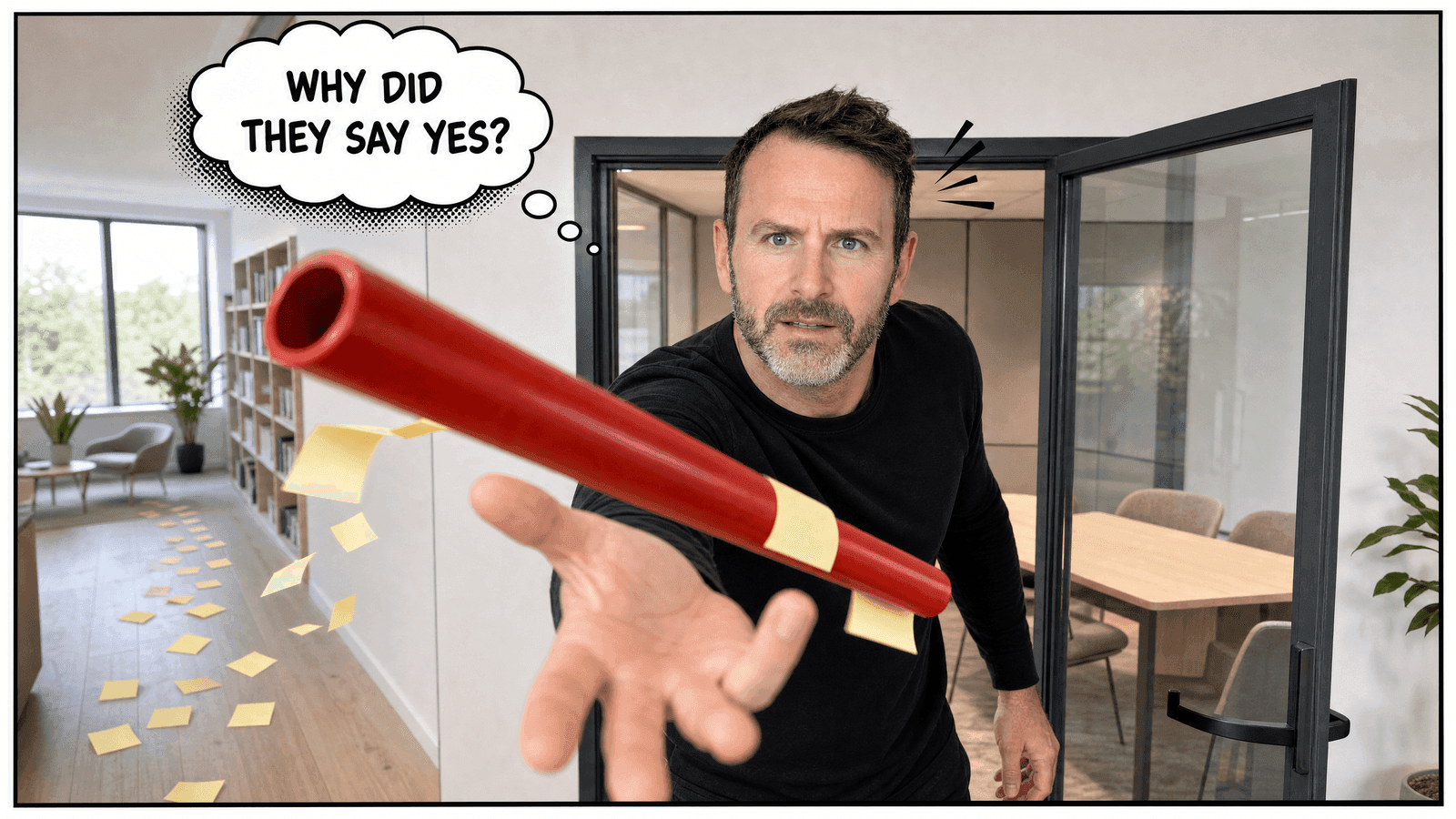
A founder we met recently has bought appointment setting for years. The verdict was mixed: the more they did themselves, the better it went, and they didn't feel they got much for the money. Their chain looked like this. Export a company list. Research the people in a professional network. Send the list to the callers. Sync to the CRM only once a meeting is booked.
Look at what that chain carries forward: a company name, a person and a time. Everything said on the phone stays with the caller.
The same week, a caller at a small agency told us they had booked seven meetings for a client and could only find six of them. Nobody knew which invite had been accepted. And chasing it, they said, shouldn't be the expert's job.
Two different conversations, one pattern. The calling works. The handoff doesn't.
The split is everywhere now
More and more teams separate booking from closing:
- an outsourced caller or agency books, and the client runs the meeting,
- a part-time or junior caller books, and a founder or senior seller runs it,
- an SDR books, and an account executive takes it,
- a caller books, and a subject-matter expert runs it, someone who often doesn't see themselves as a seller at all.
That last group is growing. One expert put it well: the first meeting should feel as unsalesy as possible, but it still has to end in a close, and anything that doesn't close goes back to the caller.
The split makes sense. Booking and running meetings are different skills, and an expert's hour is expensive. But it creates a seam, and most of what a buyer says in the first call falls through it.
Six things that get lost between booker and closer
- Whether the invite was accepted. The booker sends it and moves on. The closer assumes it's confirmed. Nobody looks until the meeting starts with an empty room.
- Why they said yes. The buyer gave a reason on the phone: a contract ending, a new hire, a problem from last quarter. It's the most valuable sentence in the whole call, and it's usually not written down.
- What was promised. "I'll ask them to bring the case from your industry." "We'll keep it to thirty minutes." The booker made the promise; the closer doesn't know about it.
- What to avoid. The buyer tried a competitor and hated it. They're tired of being pitched. They have a new boss. All of it is in the caller's head.
- Who rebooks when it falls through. A decline, a cancellation, a no-show. The closer thinks the booker owns it, the booker thinks the meeting is over. The meeting quietly disappears.
- The calls that didn't become meetings. "Interesting, but not until next year" is a real result. In most handoffs it's not handed over at all.
None of these are calling problems. A better caller doesn't fix them. A better handoff does.
The one-screen handoff
Ask your booker, or your calling partner, to hand over exactly this with every meeting. If it doesn't fit on one screen, it won't be read.
- Who: name, role, and how they relate to the decision.
- Why they said yes, in their words. One sentence, as close to verbatim as possible.
- The goal of the meeting, as agreed with the buyer, not as the seller hopes.
- What was promised, by whom, for this meeting.
- What to avoid, if anything came up.
- Acceptance status: accepted, declined, or still waiting.
The second line matters most. The closer who opens with "you mentioned your contract ends in the spring" is in a different meeting from the one who opens with "so, tell me a bit about yourselves."
Who owns what after the booking
Most handoffs fail not because nobody cares, but because nobody was told it was theirs. Write it down once:
| After the booking | Owner |
|---|---|
| Checking the invite was accepted, and chasing it if not | Booker |
| Writing the handoff | Booker |
| Reading the handoff before the meeting | Closer |
| Running the meeting and the follow-up | Closer |
| Rebooking a decline, cancellation or no-show | Booker |
| Telling the booker what happened, within a day | Closer |
That last row is the one teams skip, and it's the one that makes the booker better. A caller who never hears which meetings were qualified keeps booking the same kind of meeting. A caller who hears "good meeting, wrong size of company" adjusts next week's list.
The "call me in the spring" list is a deliverable
An agency consultant we spoke with does something worth copying. Next to the meetings booked, the client gets a report of how many companies were called, how many became meetings, and how many asked to be contacted again in the spring. The consultant delivers it as a free extra. Another appointment-setting firm even charges for it: the list of companies they spoke to and what was said, because "not relevant until next year" is a callback someone should make.
That's the right way to see it. When you buy calling, you're not only buying meetings. You're buying a map of the market as it answered the phone this month. The companies that said "later" are next quarter's pipeline, and the reason they gave is the opening line for that call.
Today that consultant builds the report by hand in a spreadsheet exported from the CRM. That's normal, and it's a sign of how little of what's said on the phone makes it into a system.
So hand it over properly: a dated list, one row per company, with the person, the date they gave, and the sentence they said.
Six rules for the handoff
- The buyer's reason travels with the meeting. If the booker can't say in one sentence why the buyer said yes, the meeting isn't ready to hand over.
- Book while you're still on the phone. Into the closer's calendar, with the buyer still on the line. A meeting confirmed in the call is far more likely to happen than one "I'll send some times."
- The booker owns acceptance and rebooking. The closer's job starts when the meeting does.
- The closer reads the handoff before the meeting, not in it. Five minutes, the morning of.
- Close the loop within a day. Held or not, qualified or not, and one sentence on why.
- Count the "later" calls as results. Report them next to meetings booked, with dates, and hand them over.
A ten-minute test
Take the last ten meetings someone else booked for you or your team. For each, without asking the booker, answer two questions:
- Why did the buyer agree to meet, in their words?
- Did they accept the invite before the meeting?
If you can answer both for eight of ten, your handoff works. If you can answer the first for fewer than half, you're paying for meetings and throwing away the most valuable part of each one.
How we do it
In Funnelfeedr, the booker books the meeting from the call, while the buyer is still on the line, into the host's calendar: pick the host, see their free times, add the invitees. The agenda is drafted from the call and goes into the invite.
On the meeting, the host sees who booked it and from which call, and a short "why this meeting was booked" with the goal and agenda, summarized from that call. Each invitee's answer shows as accepted, declined, tentative or awaiting response. Before the meeting, a pre-meeting brief arrives by email with the context from earlier calls, meetings and emails with the company, including what has happened since last time and which commitments are still open.
If the buyer declines, cancels or doesn't show up and a new time is suggested, a task to rebook lands with the host. A no-show can be marked on the meeting with one click. Show rate, meetings held out of meetings booked, can be tracked as a goal.
"Call me in the spring" is a Callback Requested outcome on the call, with a date. It becomes a dated task with the buyer's own sentence, so the later calls don't disappear.
Booking from calls is the Prospect seat. The brief and the notetaker are the Meet seat, and also part of Close.
Want to see what a meeting looks like when everything the caller heard travels with it? Book a demo and we'll show you the handoff →appointment setting · handoff · meeting booking · outsourced sales · SDR · first meeting · agency · B2B