
Admin Is a Tax Your Sales Team Pays Twice
by Oscar Uribe
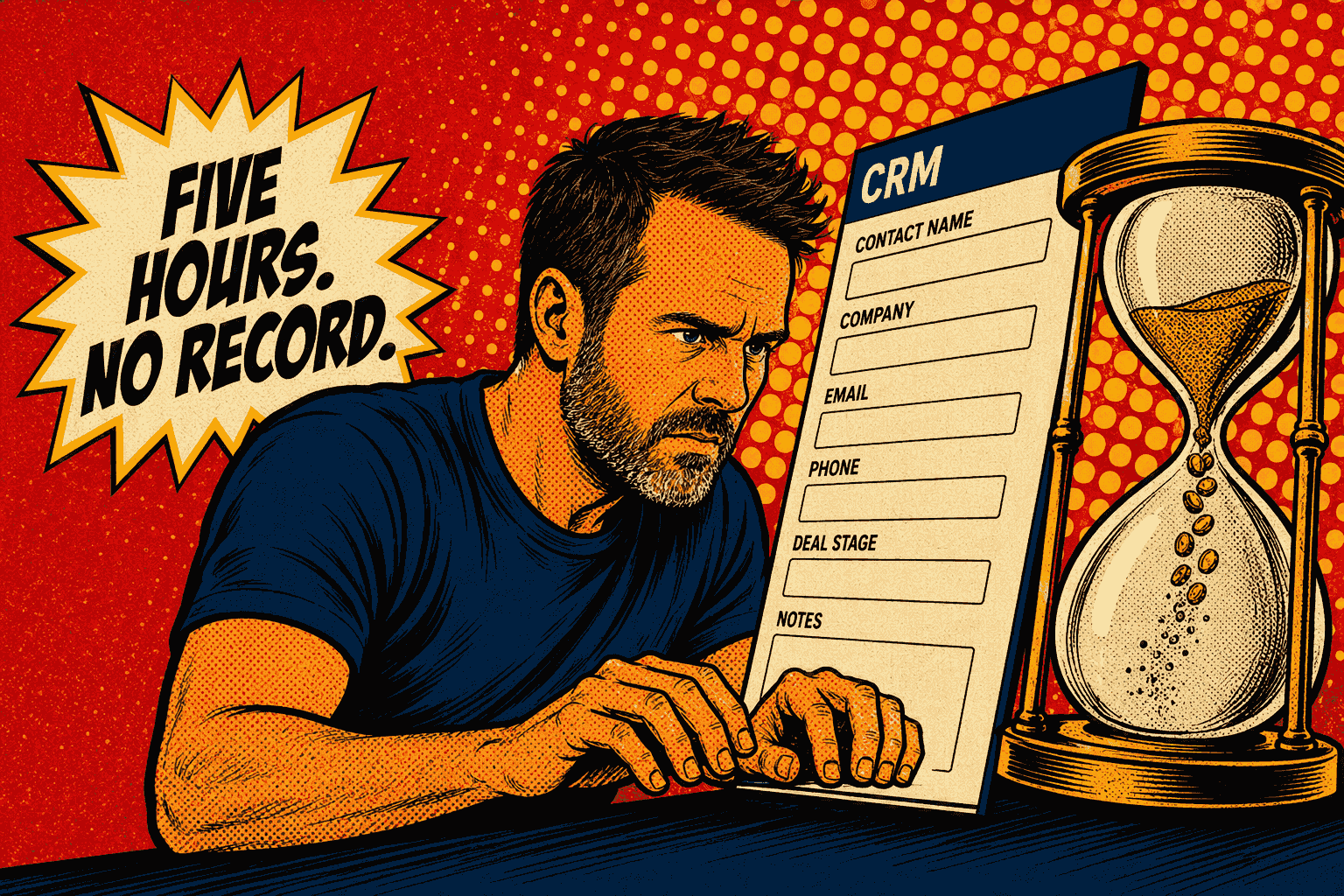
Watch a good account executive on a Tuesday afternoon. The call ends well — a real conversation, a named competitor, a budget hint, a decision maker who isn't on the deal record yet. The rep hangs up, opens the CRM, and starts typing.
Six, seven, nine minutes later there's a note in the system. It says something like: "Good call. Interested. Will send pricing. Follow up in two weeks."
Everything that mattered on that call is now gone, and it cost nine minutes to lose it.
Do that eight times a day and you've built the most expensive filing system in your company.
Five hours doesn't come out of the forty
The number that gets quoted — and it's the right number — is that 71% of reps spend five or more hours a week on manual CRM data entry, from the Forbes research on why CRM is the single biggest frustration in the profession.
Five hours out of a forty-hour week reads like 12%. Annoying, not fatal. That framing is why nobody fixes it.
But five hours doesn't come out of the forty. Look at where a rep's week actually goes: internal syncs, forecast calls, proposal writing, pre-call research, inbox, travel, the meeting about the meeting. The window in which a rep is genuinely doing the revenue-generating thing — live in front of a prospect, on the phone or in the room — is closer to twelve or fifteen hours for most B2B AEs.
Five hours of admin isn't 12% of the week. It's about a third of the part of the week that generates revenue.
And it doesn't arrive as a tidy Friday block. It arrives in four-to-nine minute slices immediately after each call — which is to say, it arrives inside the calling window, in the middle of the one stretch of the day when prospects actually answer. Every rep knows the feeling of a good calling block: three dials in, warmed up, rhythm going. Nothing kills that block faster than stopping to fill in fields.
So reps do the rational thing. They defer.
The second half of the tax
Deferring is where the bill doubles.
The same research found that 79% of opportunity-related data never gets entered at all. Not entered badly — never entered. And only 15% of sales executives describe their CRM as "very effective," which is the same finding wearing a suit.
Think about what that means as a transaction. You paid five hours a week per rep. In exchange you received a system in which four out of five things that happened in your market are simply absent, and the fifth is a paraphrase written from memory by someone who wanted to be off the phone.
That's the tax paid twice: you lose the selling hours, and you still don't get the record.
It gets worse with time, because notes written from memory don't just lose detail — they lose the right detail. A rep writing at 16:40 records what they thought was important at 16:40: their read, their optimism, their next step. What they don't record is the thing that turns out to matter in month four — the offhand remark about the procurement freeze, the name of the person who "would need to sign off," the exact words the prospect used to describe the problem, which happen to be the exact words that should appear in the proposal.
Nobody reconstructs that later. This is why the Great CRM Cleanup never works: you can't merge your way out of history that was never captured. And when the rep who held that context in their head leaves, it walks out with them.
Why "just be more disciplined" is the wrong fix
Every sales leader has tried to solve this with willpower, and it fails for three structural reasons that no amount of exhortation touches.
The incentive is upside down. The rep who logs meticulously and the rep who logs "good call, will follow up" are compensated identically. Admin has no personal upside — it's pure cost to the person doing it, and pure benefit to everyone else. You are asking commission-motivated people to volunteer.
Memory has a half-life measured in minutes. Even a rep who genuinely intends to log properly is writing a compressed reconstruction. Wait until the end of the day and you're not saving a record of the call, you're saving a record of what survived four calls of interference.
The CRM asks the wrong question. It asks for fields. What happened on the call isn't field-shaped. So the rep performs a translation — reality into dropdowns — and everything that doesn't fit a dropdown is discarded at the point of entry.
Which is also why the standard remedies backfire:
- Making fields required produces compliance, not truth. Required fields get filled with
n/a, with whatever value is first in the list, with a date two weeks out chosen because it's two weeks out. - Friday hygiene rituals move the admin, they don't remove it — and they move it to the point of maximum memory decay.
- Hiring an ops person to clean up behind the team puts a person downstream of missing information. They can standardise what exists. They cannot recover what was never written.
Discipline isn't the missing ingredient. The workflow is asking a human to be a transcription service, and humans are bad at that, especially the ones you hired for being good on the phone.
Make the CRM downstream of the call
The teams that get their hours back don't ask reps to log better. They change what the rep is being asked to do: from authoring the record to approving it.
That's three mechanical steps, and none of them require the rep to change their behaviour.
1. Capture the call itself, automatically. Every call recorded and transcribed as it happens — not as a favour to management, but because the raw material of the record is the conversation, and it already exists. Nobody has to remember anything if nothing was ever forgotten.
2. Turn the transcript into the fields that matter. A transcript is not a note; forty minutes of text nobody reads is just a longer way to lose information. The transcript has to be reduced to the things that actually drive a deal: what the prospect said they need, the objection that came up, the competitor named, the timeline mentioned, the commitment made, and the concrete next step with a date on it. That's the summary — a decision-grade record, not a paragraph of narrative.
3. Write it back into the CRM, both ways. The summary lands on the right company and the right deal in HubSpot or Pipedrive, the activity is logged, the follow-up task exists, the deal has moved. Two-way, so the CRM stays the system of record your forecast and your reports run on — the rep just stops being the transport layer between the call and the database.
What's left for the rep is a ten-to-forty-second review: glance at the draft, fix the one thing the summary read too optimistically, add the thing only they know, done. Reviewing is fast and reliable. Authoring is slow and lossy. That single swap is most of the win.
The side effect is the part leaders underestimate: because the capture is automatic, it happens on every call — including the disqualified ones, the no-shows, the "call me after the summer." Those are the calls nobody has ever logged, and they're the ones that tell you why a segment isn't converting.
What the recovered hours are actually worth
Five hours a week, across roughly 46 working weeks, is 230 hours per rep per year — about six full working weeks.
Say you recover two-thirds of it, which is realistic when the rep goes from writing to approving. That's four weeks of selling time back, per rep, per year. On a team of eight, you've just found the output of roughly two-thirds of an extra head without recruiting, onboarding, or ramping anyone.
Then run it through the funnel rather than the payroll. Four recovered weeks is a meaningful number of extra conversations per week, and we've done the math on what a single extra meeting per week compounds into — it's not a rounding error, it's the difference between a rep who makes quota and one who doesn't.
And you get the second half of the tax back too: a CRM that actually contains what happened, which is what makes forecasting something other than a vibe.
Measure the lag, not the compliance
If you want to know whether this is fixed, stop measuring CRM compliance. Compliance measures whether fields are populated, and populated fields are exactly what a rep produces when they're gaming a mandate.
Three better numbers:
- Time from call ending to record existing. In a broken workflow it's hours or days. Fixed, it's seconds. This is the single most diagnostic metric you have.
- Share of calls with a real logged outcome — including the bad ones. If your CRM only contains calls that went well, you're forecasting on a biased sample.
- Self-reported admin hours per rep per week. Ask them. They know the number, and they will tell you with feeling.
Track those per rep and per month, and the effect of any change you make shows up within a cycle. Track "CRM completeness" and you'll be looking at a chart that goes up while nothing improves.
The takeaway
Admin doesn't feel like a strategic problem, which is why it survives so long. It arrives in nine-minute pieces, it never causes a crisis, and every quarter somebody proposes fixing it with more discipline.
But it takes a third of the only hours that produce revenue, and it hands back a record that's four-fifths empty. That's not a hygiene issue. That's a structural leak in the part of the business you care most about.
The fix isn't asking reps to type faster. It's making the record a byproduct of the conversation instead of a chore that follows it.
That's how Funnelfeedr is built: every call transcribed automatically, summarized into the things that actually move a deal — next step, objection, competitor, timeline — and synced two-way into HubSpot or Pipedrive against the right company and deal. The rep's job goes back to being the call. The CRM fills itself in behind them.
Want to see what your reps' Tuesday afternoon looks like without the nine minutes? Book a demo and we'll walk through the call-to-CRM flow →