
The Founder Sales Stall: Why Selling Stops Every Time Delivery Gets Busy
by Oscar Uribe
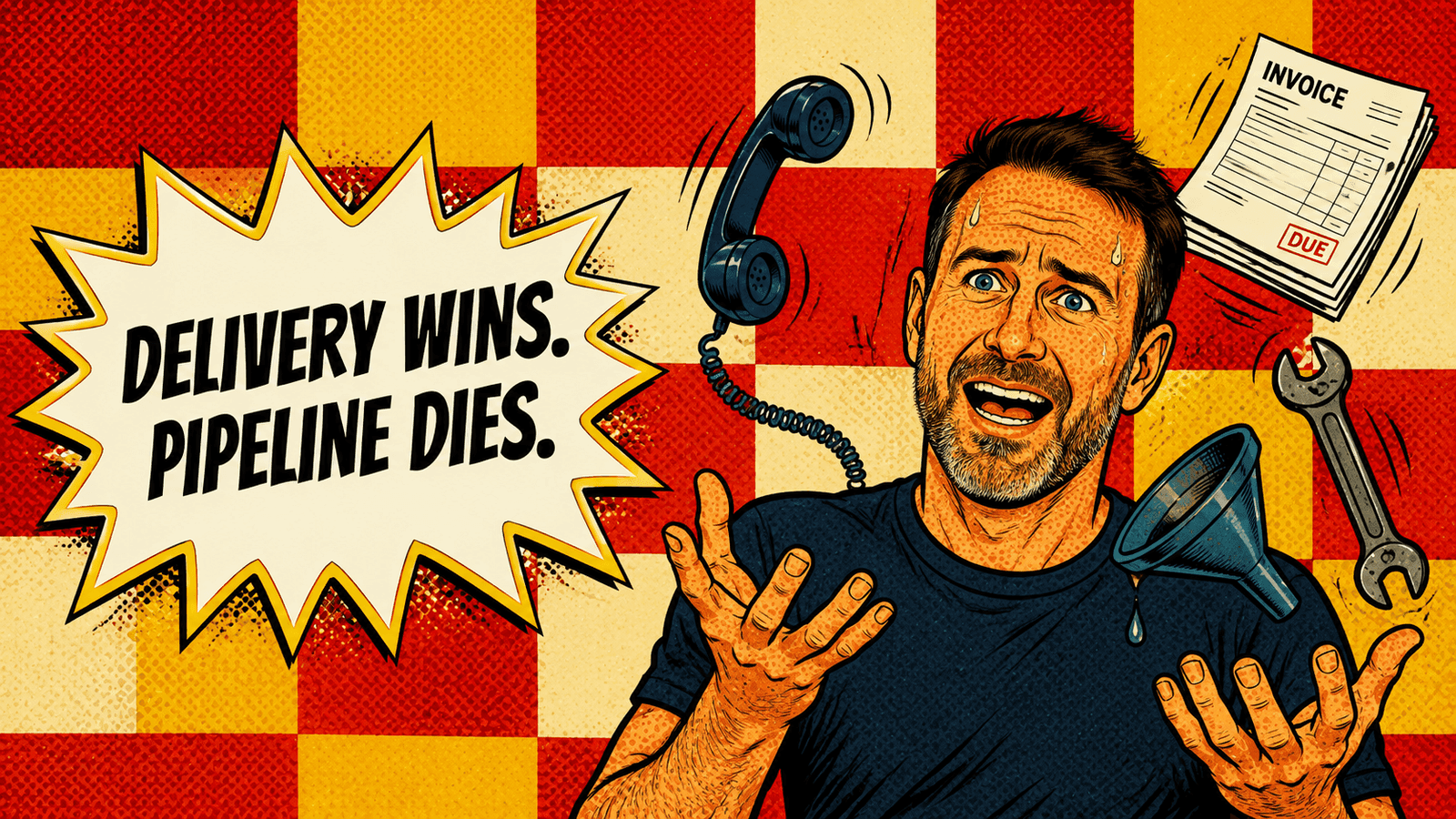
Most companies under twenty people don't have a sales problem. They have a sequencing problem.
The founder sells. The founder is good at it — better than any rep they'll ever hire, because they know the product, they know the market, and the buyer takes them seriously. So they sell, they win three or four customers, and then those customers need onboarding, support, a feature conversation, an invoice question, a quarterly check-in.
And the selling stops. Not deliberately. Nobody decides to stop prospecting. It just quietly loses every scheduling conflict for four months, and then a customer doesn't renew and the whole thing becomes urgent again — at exactly the moment it's too late to matter.
If you're a founder or CEO carrying the sales function yourself, you already know the shape of this. What's worth looking at is why it happens, because it isn't a discipline problem, and treating it as one is why it keeps happening.
Delivery has deadlines. Pipeline doesn't.
Here's the mechanism, and it's almost mechanical.
Every task in your delivery work has another human attached to it. A customer is waiting. Somebody sent an email on Tuesday and expects an answer by Wednesday. There's a go-live date, a support ticket, a person who will visibly be disappointed if you don't do the thing.
Prospecting has none of that. Nobody is waiting for your outreach. No prospect emails you to ask why you haven't followed up. There is no external consequence to skipping a week — and the cost of skipping it doesn't arrive for another three to six months, by which time it's indistinguishable from bad luck or a slow market.
So on any given Tuesday, with four hours and six things to do, the rational move is always to serve the customer in front of you. Selling isn't losing to laziness. It's losing to the only tasks in your week that have a name attached. Do that forty times in a row and you've built a company where revenue only moves when something breaks.
The cost isn't the lost customer. It's the lag.
Founders tend to price a churned customer at the value of that customer. That's the small half of the bill.
Take a company at €600,000 in annual recurring revenue across twelve customers — €50,000 each, which is a very normal Nordic B2B shape. One customer leaves in September. The founder, who hasn't done real outreach since May, starts again in October.
Now count the calendar:
- Four to six weeks to rebuild any kind of live conversation flow from a cold start, because the list is stale, the old threads are dead, and the first ten conversations are re-learning what the pitch even is.
- A four-month sales cycle from first real conversation to signature — again, normal for a €50k deal with more than one person involved.
- Two to eight weeks from signature to the revenue actually landing.
That's the replacement customer signing in February and paying in March. The €50,000 hole was open for six months, so the direct cost is roughly €25,000 in lost revenue on top of the account itself.
But the bigger number is the one that never shows up in any report: during those five stalled months you weren't building the pipeline that would have grown you. The pipeline you're building in October isn't growth. It's repair. You're paying full price for pipeline and receiving zero net new revenue for it, and you'll do it again the next time a customer leaves — which is how a company spends four years bouncing between €500k and €700k while working extremely hard.
The sawtooth isn't a market condition. It's a scheduling artifact.
What "continuous" actually means when you're the whole sales team
The standard advice here is to block time, and it's not wrong, it's just not sufficient — a calendar block with nothing prepared inside it becomes an hour of staring at a list and deciding to do it properly next week.
What actually holds is a floor: the smallest amount of sales movement you'll still do in your worst week. Not your best week. Your worst one.
For most founder-led companies that floor looks something like:
- Five live conversations a week. Calls, meetings, real replies — not emails sent. Five is small enough to survive a bad week and large enough that pipeline never fully drains.
- Zero deals without a next step. Every open opportunity has a specific action with a date on it. Not "follow up soon."
- One deliberate re-approach a week into something dormant: a lost deal from last year, a stalled thread, a customer who churned on price when you were a different product.
That's maybe three hours. The reason it fails isn't the three hours — it's that in hour one you're reconstructing from memory what happened in a conversation five weeks ago, what you promised, and which of eleven half-open threads is actually alive. The overhead of restarting is what kills founder-led selling, not the selling itself.
Which is the actual argument for having sales operations even when you have no salespeople: the point of the system isn't reporting, it's removing the restart cost. When you sit down on Thursday, the open deals are already sorted by what's rotting, the notes from the last call are already written, and there's a drafted email waiting under each one. Three hours of selling becomes three hours of selling, instead of ninety minutes of archaeology and ninety minutes of selling.
That's a large part of what we built Funnelfeedr to do — surface which conversations have gone quiet, keep every deal carrying a next step, and turn the calls you already had into the record you'd otherwise write by hand at 9pm.
The pipeline you already have and aren't selling to
Here's the part that's almost free and almost universally skipped.
Founder-led companies chronically under-sell their existing base. Not because they don't want the revenue, but because the founder is also the delivery lead, and when you're in the service seat every conversation gets read as service. A customer says "we're doing the same thing manually over in the operations team" — and the founder hears a workflow anecdote, nods sympathetically, and moves on. Six months later that team buys something else to do it.
Expansion revenue is the cheapest revenue in the company. No list building, no cold outreach, no trust to establish, cycles that are a fraction of a new logo's. And the signals are already sitting in conversations you've already had: a new department mentioned, a hire that changes the use case, a competitor named, a manual process described out loud, a "we'd love to do that eventually."
The problem is that those signals arrive in a service context and get filed as service. Nobody is reviewing eleven months of customer calls looking for the sentence where somebody said "the other team could use this too."
Something should be. In Funnelfeedr that's what the call and email intelligence does in the background — reading what was actually said and putting expansion signals, new stakeholders and unaddressed needs onto the account record, so a quarterly check-in starts from "you mentioned the operations team back in March, is that still manual?" instead of "so, how's everything going?"
You don't need to become a sales-driven company to capture this. You need to stop letting it evaporate.
Getting the hours back: the follow-up debt
Ask a founder what specifically stops them from selling more and you rarely get "I can't find prospects." You get some version of: I owe eight people an email.
Follow-up debt is the real tax. The proposal recap you've been meaning to write since Tuesday. The three-paragraph answer to a technical objection. The "just checking in" that you refuse to send because it's embarrassing, so you write nothing at all and the deal dies of silence rather than of a decision.
Each of those is fifteen to twenty-five minutes of real writing, and it needs to sound like you — which is precisely why you can't delegate it and precisely why it doesn't get done.
Drafting is the piece that automates well, because everything it needs is already on record: what the buyer asked, what you promised, what you sent, what they objected to. Funnelfeedr drafts the follow-up from the actual conversation and leaves it sitting there for you to edit and send. Twenty minutes becomes two. Nothing goes out without you reading it, which matters — the version where AI emails your prospects unsupervised is not a version any founder should want.
Eight emails a week at twenty minutes each is a full working day a month. That's not a productivity statistic. That's the difference between five live conversations a week and none.
The reason to do this before you hire, not after
Most founders plan to fix all of this by hiring a salesperson. Then the first hire underperforms for two or three quarters, everyone concludes sales hiring is hard, and the founder quietly takes the pipeline back.
The hire usually isn't the problem. The problem is that everything making the founder good at selling exists nowhere except inside the founder. Which objections come up and what actually answers them. Which questions in the first call predict a deal that closes. Which industries buy fast and which ones waste four months. What you say when they ask about the missing feature. Why you lost the last three.
None of that is written down. It can't be handed over in an onboarding week, so the new rep reconstructs it from scratch by losing deals for six months — and every deal they lose learning it is a deal you would have won.
This is the whole argument for putting the sales process in the system rather than in someone's head. If your calls and emails run through a workspace that builds a knowledge base as you go — your objections and the answers that work, your qualification criteria, the patterns from won and lost deals — then by the time you hire, the thing you were going to spend six months explaining already exists. New rep, day one, gets your objection handling live in the call rather than a PDF and good luck.
That's a large part of what Funnelfeedr does: capture how selling actually works in your company while you're doing it, so the first hire inherits a process instead of a vacuum. Do it before you hire and onboarding is weeks. Do it after and it's quarters — and the knowledge is still trapped in your head, now with an audience of one confused new employee.
There's a bonus that's easy to miss: externalising your sales process is also what makes the company sellable, fundable and survivable. A company whose sales function is one person's intuition has a single point of failure at the top.
What to do this week
None of this requires a transformation programme. In order:
- Set the floor and make it small. Five live conversations a week, written down, defended like a customer deadline. A floor you actually hold beats a target you abandon in week three.
- Give every open deal a dated next step. Anything without one isn't a deal, it's a memory. Close it or act on it.
- Read your own customer base as pipeline. List every account. For each: what have they mentioned that you never followed up on? Book those conversations. That's usually a quarter of pipeline sitting in plain sight.
- Stop hand-writing follow-ups from scratch. Whatever tooling you use, the draft should come from the conversation, not from a blank page.
- Start capturing the process now. Every call you take between today and your first sales hire is either training material or it's gone.
And no, you don't need a CRM in place first. Plenty of founder-led companies run this out of an inbox and a good memory, and the honest starting point is a system that captures what happens in your conversations — a CRM can come later, or sit alongside it when you're ready.
The takeaway
The founder sales stall isn't a motivation failure and it isn't fixed by trying harder. It's structural: delivery has deadlines, selling doesn't, and the consequences of stopping arrive one to two quarters after the decision to stop — long after you could have done anything cheap about it.
You fix it by lowering what continuous costs. Make restarting cheap, make follow-ups fast, mine the customers you already have, and let the system remember your sales process so that the day you finally hire, you're handing over an asset instead of an anecdote.
The companies that break out of the sawtooth aren't the ones that sold hardest in the panic months. They're the ones that never fully stopped.
Selling on your own and want the restart cost gone? Book a demo and see how Funnelfeedr keeps founder-led sales moving →