
Why Your Meeting-Booking Agency's Booking Rate Is Capped by Data, Not Reps
by Oscar Uribe
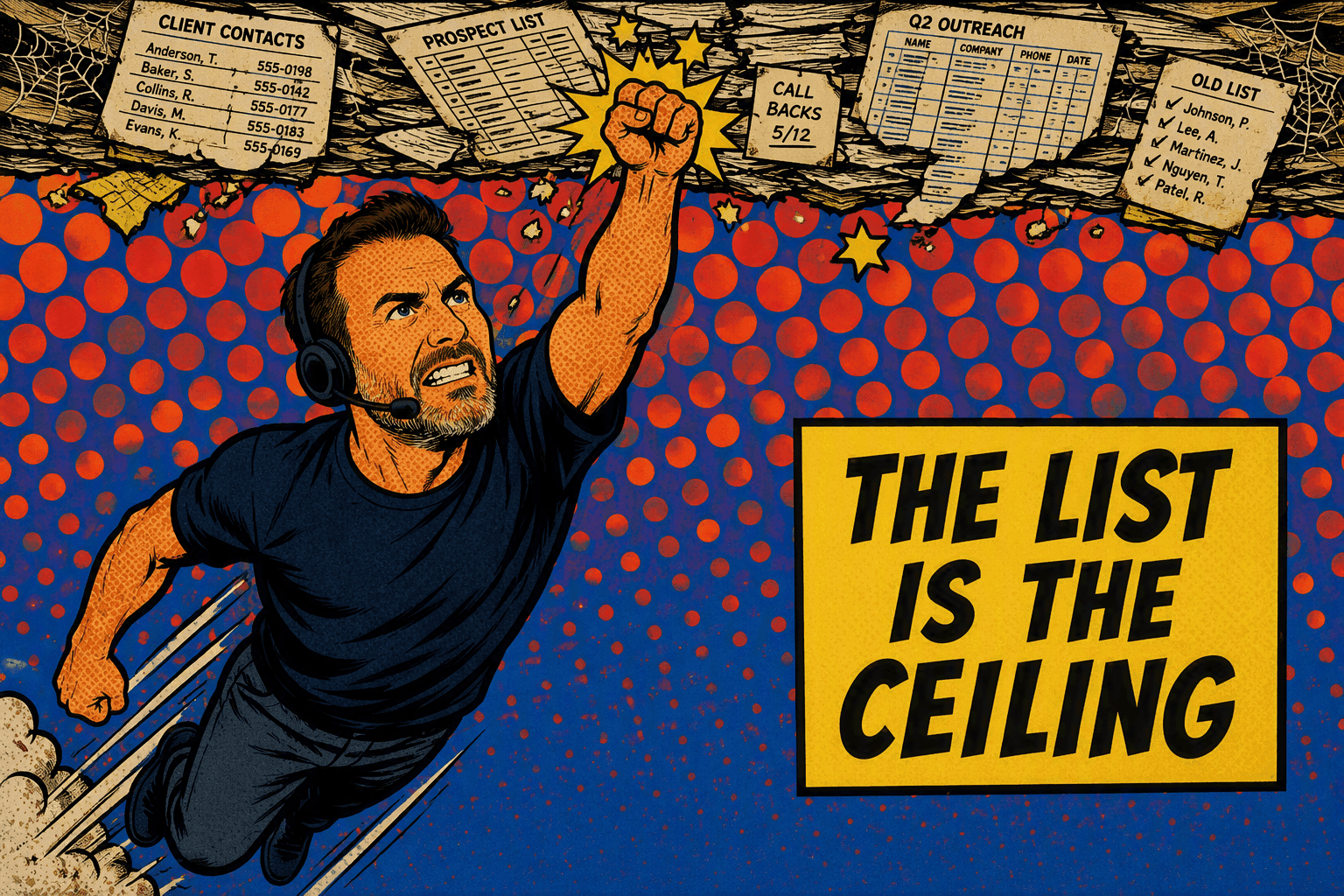
Every meeting-booking agency has run this play. A booker's numbers dip, so you sit in on their calls. You tighten the script. You run the objection drills again. You up the dial count. And the needle moves — a little, for a while — before settling right back where it was.
Here's the possibility almost nobody at the whiteboard wants to raise: the booker was never the bottleneck. The list was. And no amount of coaching moves a number that's set before the first dial of the day.
The math of a booked meeting
Strip the craft away for a second and booking is a funnel of three multiplications:
dials × connect rate × conversation-to-meeting rate = meetings
Coaching lives in the last multiplier. Scripts, tonality, objection handling — all of it operates on the conversations a booker actually has. It matters, and good agencies rightly obsess over it.
But look at the middle multiplier. Connect rate — the share of dials where a human who still works there picks up — isn't a skill. It's a property of the list. A disconnected number doesn't care how good your opener is. Neither does a decision-maker who left the company in 2023, or a switchboard for a business that quietly folded last spring.
Now run the numbers. A booker making 300 dials a day on a list with a 15% connect rate gets 45 conversations. The same booker, same script, same energy, on a list connecting at 40% gets 120. Even a coaching breakthrough that lifts conversion from 10% to 12% — a big win — adds a fraction of what the better list adds by simply tripling the conversations that conversion rate gets applied to. We've written about what a 43% connect rate takes, and the short version is: it's built in the data layer, not the call.
The uncomfortable conclusion for anyone who sells coaching, us included: the list sets the ceiling, and the booker decides how close to the ceiling you get. Most agencies work relentlessly on the second part while renting the first.
Why agencies feel this harder than anyone
An in-house SDR team with mediocre data has a bad quarter. An agency with mediocre data has an existential problem, for three reasons that compound:
You're paid per meeting, so data quality is your margin. When the connect rate drops, the cost of every booked meeting rises in direct proportion — same salaries, fewer billable outcomes. A soft list doesn't feel like a data problem on the P&L; it feels like the whole business getting heavier.
You burn segments faster than anyone. A team dialing at agency volume exhausts a niche in weeks. And when a segment runs dry mid-engagement, output doesn't taper politely — it cliffs, right when the client dashboard is being watched most closely. Volume that fluctuates reads as inconsistency to the client, even when the real story is that the addressable list simply ran out.
Your clients judge the meetings, not the dials. Wrong-fit accounts sneak into a tired list, bookers book them anyway (they're paid to), and the client sits through meetings with companies that were never going to buy. Nothing erodes an agency relationship faster than delivered-but-worthless meetings — and that failure is invisible in every metric except the one that matters: renewal.
The three data failure modes that cap booking rate
When we look at where agency booking rates actually leak, it's almost always one of three holes:
- Dead ends. Stale numbers, departed contacts, dissolved companies. This is pure connect-rate tax, and it grows on its own: B2B contact data decays at 25–40% a year, so a list that connected fine in January is quietly worse every single week. We unpacked that decay — and why the fix is maintenance, not sourcing — in why contact lists go stale.
- Wrong-fit accounts. The client's ICP was translated into a blunt industry code and a headcount range, and the list came back technically correct and practically useless. Fit problems don't hurt connect rate; they hurt everything after the meeting is booked — show rate, conversion, and the client's trust.
- Segment exhaustion. Nobody's watching how much addressable market is left in the current cut. The pipeline of lists — not the pipeline of meetings — is the real supply chain of an agency, and most agencies manage it reactively, one scramble at a time.
Notice that none of these are fixable in the calling room. A better opener fixes none of them. A great booker on a leaking list is a race car in traffic.
What the fix actually looks like
The good news: in the Nordics, this is a solvable problem, because the raw material is unusually good. Official company registries (Bolagsverket, Brønnøysundregistrene, PRH, Virk) give you a company layer that's refreshed by legal obligation — bankruptcies, name changes, and address moves flow in as filings, not as guesses. Anchor your lists there and the three failure modes each get a concrete answer:
- Against dead ends: per-record freshness — every contact re-verified on a cycle, scored for accuracy, and pruned when it stops checking out. A smaller list that answers the phone beats a bigger one that doesn't; your connect rate is the proof.
- Against wrong fit: segment on what companies actually do — tags, keywords, tech signals — instead of blunt industry codes, so each client's ICP translates into a list that resembles their best customers rather than their industry's phone book.
- Against exhaustion: continuous list generation instead of one-time cuts. When new companies matching a client's profile appear in the registry data, they should appear in the queue — automatically, before the current segment runs dry.
This is the model Funnelfeedr is built on for agency teams: lists generated per client ICP on registry-anchored Nordic data, verified decision-makers attached, and a built-in dialer so the queue, the call, and the outcome logging live in one place. Bookers spend their day where their skill actually moves the number — in conversations — instead of hunting for someone to call.
The takeaway
If your booking rate has plateaued, audit the list before you audit the booker. Check the connect rate trend, count the wrong-fit meetings your clients quietly tolerated last quarter, and ask how many weeks of addressable market are left in each active segment. If those numbers are ugly, no script rewrite will save the quarter — because your reps aren't underperforming. They're performing exactly to the ceiling your data set for them.
Raise the ceiling, and the same team books more with the same effort. That's the cheapest growth an agency can buy.
Want to see what your booking economics look like on registry-anchored, continuously maintained data? Book a demo and we'll pull a live list for one of your client ICPs →